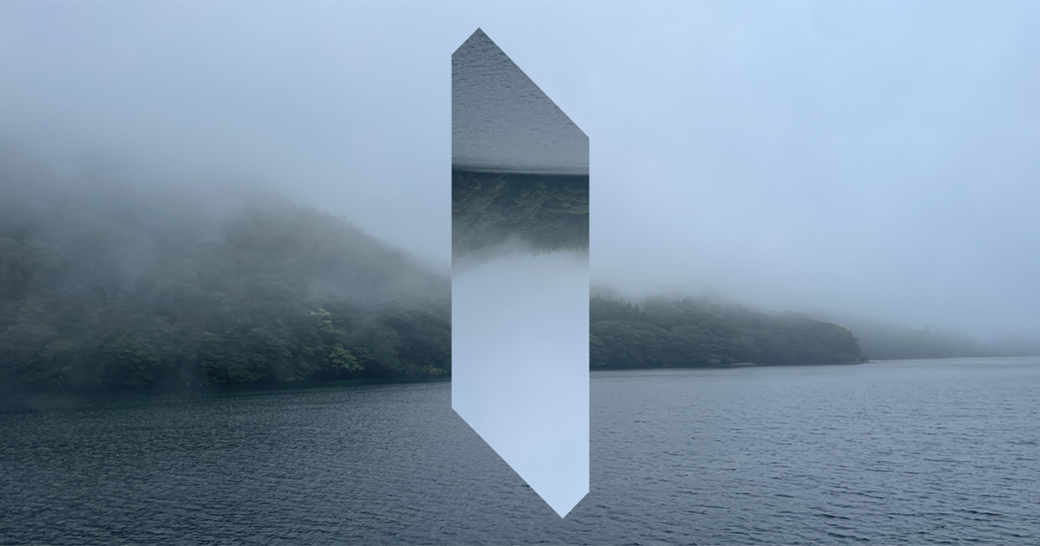
2026, site web, photographie
https://www.reynalddrouhin.net/works/monolith-process
Monolith Process est une réactivation en 2026 de Monoliths, projet développé entre 2015 et 2020. Il reprend le principe initial de permutation photographique tout en simplifiant son dispositif. L’archive publique et les fonctions de partage de la première version ont disparu afin de recentrer le projet sur l’expérience de manipulation et sur la règle qui produit la forme.
Le principe est simple : le monolithe n’est jamais ajouté à la photographie comme un objet extérieur. Il apparaît à partir de l’image elle-même. Une zone est découpée, déplacée, retournée et recomposée selon une géométrie réglable. L’utilisateur intervient sur la position, les proportions, l’orientation et les conditions de visibilité de la forme. La photographie devient ainsi une matière transformable, soumise à une série d’opérations qui en déplacent localement la continuité.
L’interface assume pleinement cette dimension d’outil. Les curseurs, les réglages et les variations de rendu ne sont pas périphériques au projet : ils constituent le lieu même de l’expérience. Chaque manipulation modifie la relation entre l’image initiale et la forme qui en émerge. Il ne s’agit donc pas seulement de produire une image finale, mais d’explorer la manière dont une photographie peut être fragmentée, déplacée et reconfigurée par le code.
Le monolithe traverse plusieurs projets comme une forme minimale, stable mais ouverte à différentes interprétations. Sa présence renvoie inévitablement à 2001: A Space Odyssey, mais cette référence ne se limite pas au monolithe noir du film de Stanley Kubrick. Dans le roman d’Arthur C. Clarke, le premier monolithe rencontré à l’aube de l’humanité est décrit comme une structure cristalline et translucide, traversée par la lumière, tandis que d’autres monolithes apparaissent ensuite comme des formes noires. Cette variation permet de considérer le monolithe moins comme un objet figé que comme une forme dont le statut et l’apparence dépendent des conditions dans lesquelles elle surgit.
Dans Monolith Process, cette forme devient avant tout un opérateur. Elle ne vient pas interrompre l’image depuis l’extérieur, elle révèle une transformation qui se produit à l’intérieur de celle-ci. Le monolithe est à la fois résultat et indice du processus qui l’a fait apparaître.
La réactivation de 2026 déplace ainsi le centre du projet. Là où Monoliths articulait production d’images, participation et circulation sociale, Monolith Process se concentre davantage sur l’outil, la manipulation et le protocole lui-même.
Le projet déplace ainsi l’attention de l’objet représenté vers les conditions de son apparition. Ce qui compte n’est pas seulement le monolithe visible, mais le processus qui le fait émerger de l’image.
Monolith Process is a 2026 reactivation of Monoliths, a project developed between 2015 and 2020. It revisits the original principle of photographic permutation while simplifying the system. The public archive and sharing functions of the first version have been removed in order to refocus the project on the experience of manipulation and on the rule that produces the form.
The principle is simple: the monolith is never added to the photograph as an external object. It appears from within the image itself. A section of the image is cut, displaced, flipped, and recomposed according to an adjustable geometry. The user can modify the position, proportions, orientation, and conditions of visibility of the form. The photograph thus becomes a transformable material, subjected to a series of operations that locally disrupt its continuity.
The interface fully embraces this dimension as a tool. Sliders, controls, and variations in rendering are not peripheral to the project: they constitute the very site of the experience. Each manipulation modifies the relationship between the initial image and the form that emerges from it. The aim is therefore not simply to produce a final image, but to explore how a photograph can be fragmented, displaced, and reconfigured through code.
The monolith has appeared across several projects as a minimal form, stable yet open to different interpretations. Its presence inevitably refers to 2001: A Space Odyssey, but this reference is not limited to the black monolith in Stanley Kubrick’s film. In Arthur C. Clarke’s novel, the first monolith encountered at the dawn of humanity is described as a crystalline, translucent structure traversed by light, while other monoliths later appear as black forms. This variation makes it possible to consider the monolith less as a fixed object than as a form whose status and appearance depend on the conditions in which it emerges.
In Monolith Process, this form functions above all as an operator. It does not interrupt the image from the outside; it reveals a transformation taking place within it. The monolith is both the result and the trace of the process that brings it into view.
The 2026 reactivation thus shifts the center of the project. Where Monoliths combined image production, participation, and social circulation, Monolith Process focuses more closely on the tool, the act of manipulation, and the protocol itself.
The project thus shifts attention away from the represented object and toward the conditions of its appearance. What matters is not only the visible monolith, but the process through which it emerges from the image.