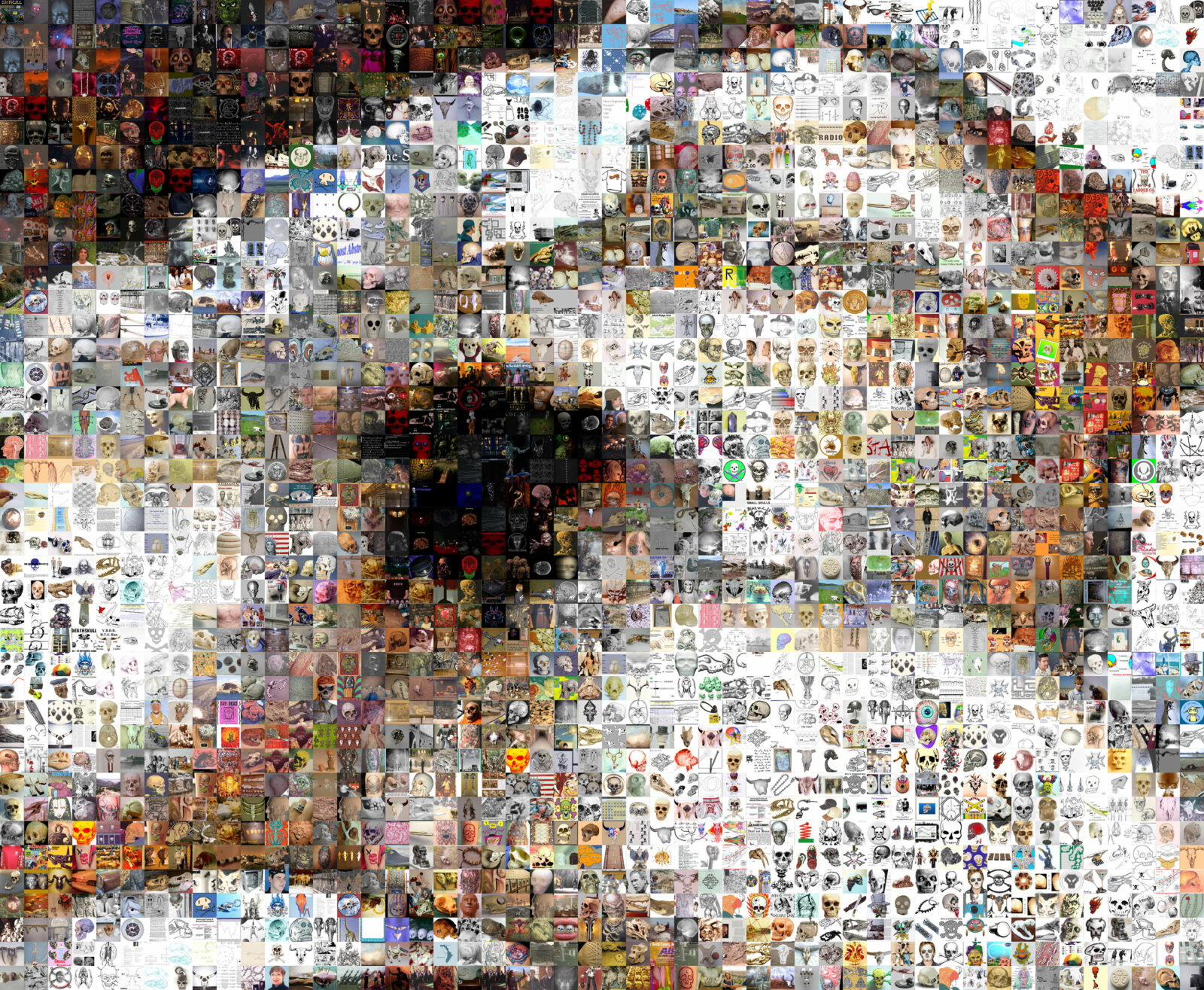
Butterfly # Om

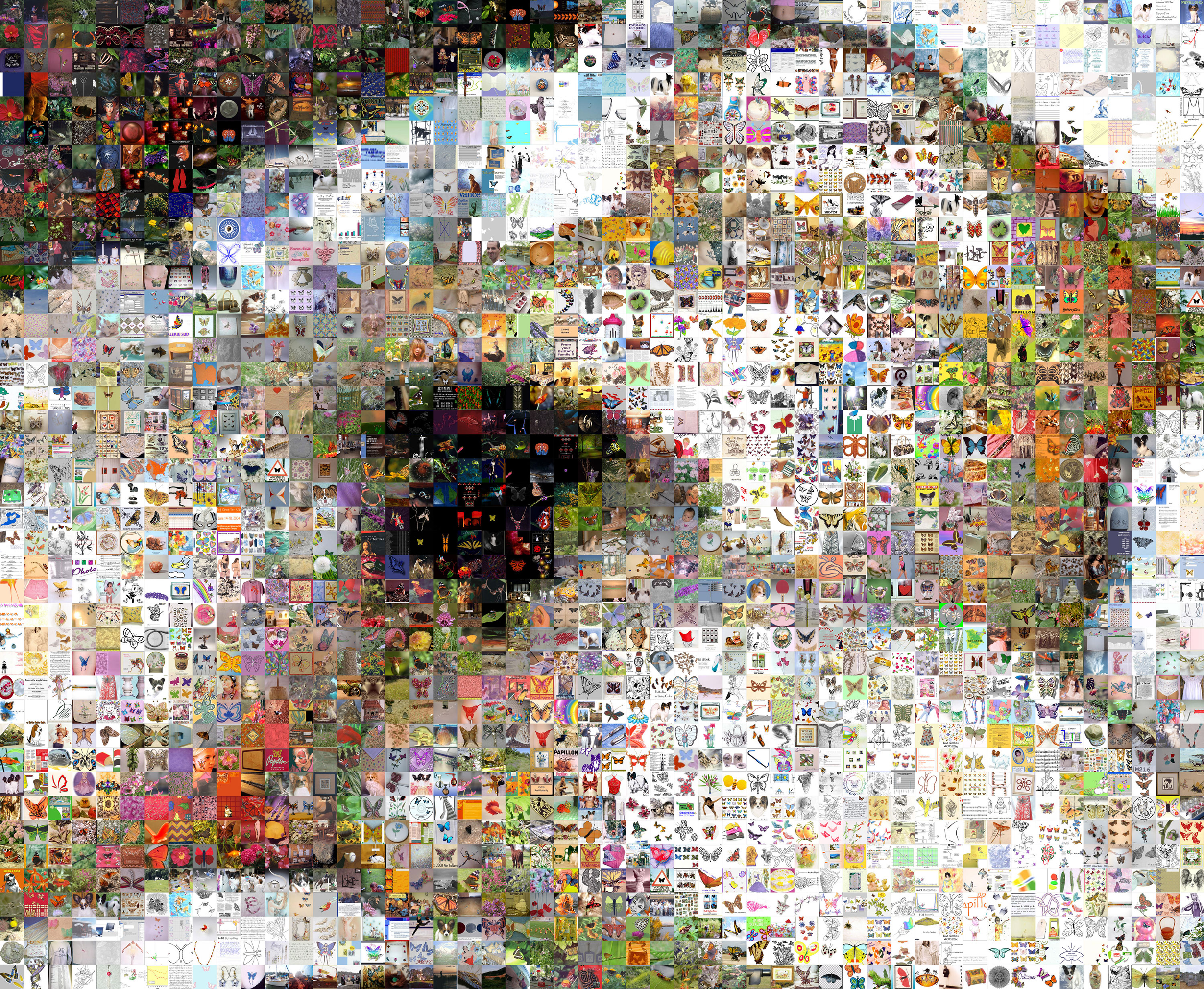
Eye # Om
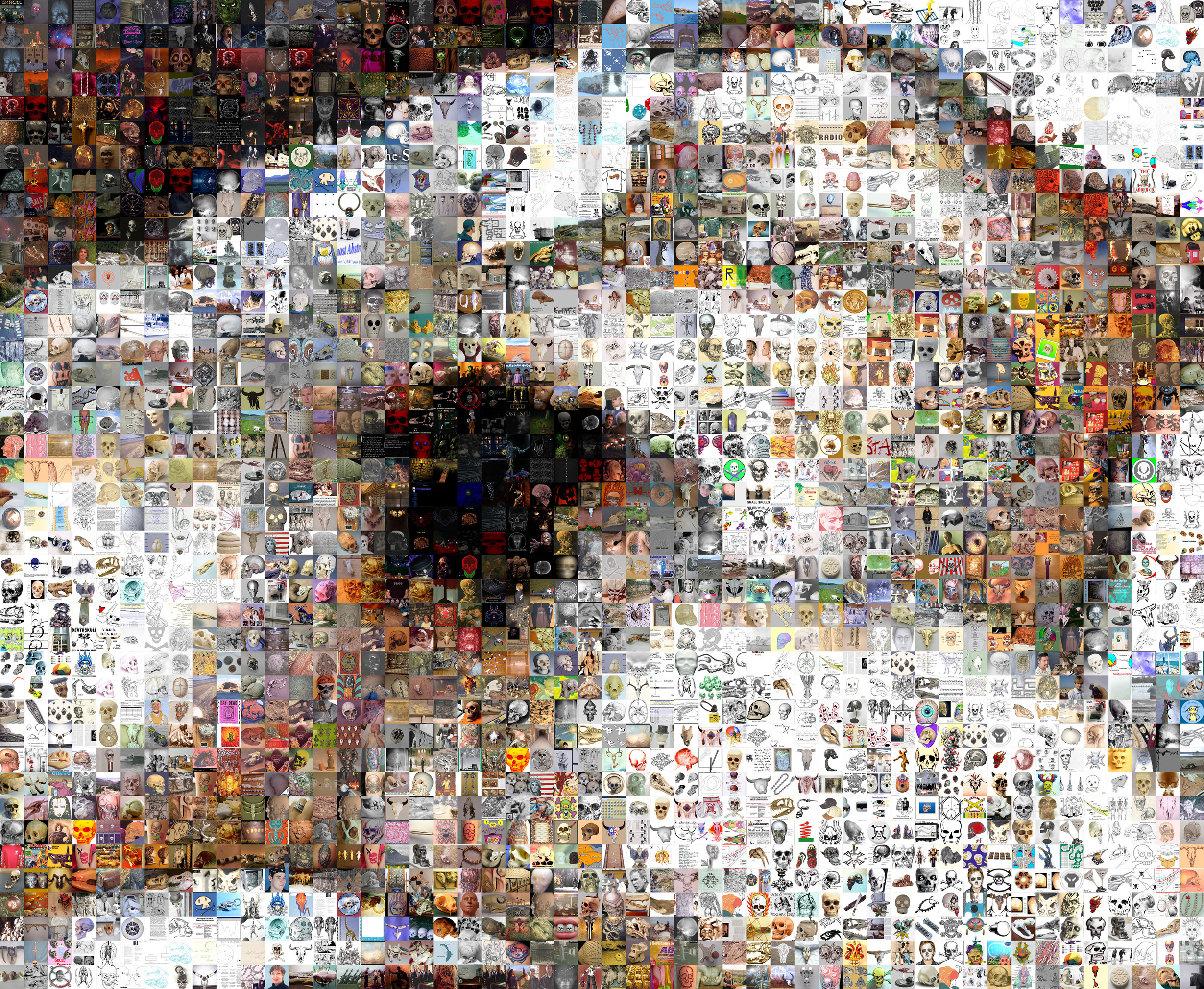
Skull # Om
3 tirages lambda sur diasec avec chassis aluminium, 56 x 46 cm.
Begun in 2001, Origines is a photographic series based on an automatic process of recomposing images found on the Internet. A source image serves as a matrix, while thousands of images retrieved from the Web are classified according to hue, saturation, and brightness, then assembled to progressively reconstruct its structure.
The first work in the series reinterprets Gustave Courbet’s The Origin of the World. The historical image is neither reproduced nor simply appropriated: it is reconstructed from another corpus, that of the images circulating online at the time. Each fragment has its own origin, context, and content, yet temporarily becomes part of a collective image.
This process, described as a “defragmentation of the Internet through images,” transforms the network into a vast visual database. Search engines and indexing systems determine what can be found, while the algorithm organizes these fragments according to the characteristics of the source image. Two logics thus intersect: that of a pre-existing image and that of the constantly shifting archive of the Web.
The result is necessarily unstable. Online images, their indexing, and their ranking are constantly changing. A recomposition generated moments, months, or years later could never be exactly identical. Each photograph fixes a provisional state of the network through an image that existed before it.
With Butterfly # Om, Eye # Om, and Skull # Om, the process extends to other matrices and other sets of images. The notion of “origin” therefore shifts: it no longer refers only to Courbet’s image, but to the question of provenance itself. Where does an image come from when it is composed of thousands of other images? From the matrix that organizes it, the fragments that constitute it, the network that makes them accessible, or the protocol that brings them together?
Origines situates the image precisely within this intermediate space. From a distance, a single representation imposes itself; up close, it disperses into a multitude of autonomous images. Unity emerges from fragmentation, while the Internet becomes simultaneously material, archive, and provisional memory.