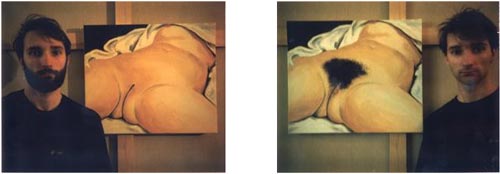
Réalisé en 1992, Origine est un diptyque de Polaroids construit autour d’une reprise de L’Origine du monde de Gustave Courbet. Dans la première image, l’artiste apparaît barbu devant une version dont la pilosité pubienne a été effacée. Dans la seconde, son visage est rasé et les véritables poils de sa barbe ont été collés sur cette même image, à l’emplacement de la pilosité disparue.
Le déplacement n’est donc pas seulement visuel ou symbolique. Une matière prélevée sur le corps passe physiquement du visage masculin au sexe féminin représenté. La barbe devient pilosité pubienne et un fragment réel du corps de l’artiste entre dans l’image pour en modifier matériellement la surface.
Les deux Polaroids enregistrent deux états successifs d’une même transformation. La peinture utilisée au cours du processus a ensuite été détruite et n’existe plus. Elle n’était pas la finalité du travail, mais le support d’une opération dont les photographies constituent aujourd’hui la seule trace et l’œuvre elle-même. Le premier Polaroid conserve un état qui avait déjà disparu au moment où le second était réalisé.
Le titre reprend celui de Courbet tout en déplaçant la question de l’origine. D’où vient désormais ce qui constitue l’image ? De la représentation initiale, du corps de l’artiste, de la matière transférée ou de l’opération qui les relie ? Ce qui appartenait au corps devient partie de la représentation, tandis que l’objet sur lequel cette transformation a eu lieu finit lui-même par disparaître.
Par une opération minimale de prélèvement, de transfert et de disparition, Origine met ainsi en tension autoportrait, corps, genre, représentation et mémoire. L’œuvre ne réside finalement ni dans la peinture ni dans le geste seul, mais dans les deux traces photographiques qui en conservent l’avant et l’après.
Created in 1992, Origine is a diptych of Polaroids constructed around a reinterpretation of Gustave Courbet’s The Origin of the World. In the first image, the artist appears bearded in front of a version in which the pubic hair has been removed. In the second, his face is shaved and the actual hairs from his beard have been attached to the same image, replacing the missing pubic hair.
The displacement is therefore not merely visual or symbolic. Material taken from the body physically moves from the male face to the represented female sex. The beard becomes pubic hair, and a real fragment of the artist’s body enters the image and materially alters its surface.
The two Polaroids record two successive states of the same transformation. The painting used during the process was subsequently destroyed and no longer exists. It was not the final work, but the temporary support for an operation of which the photographs are now the only remaining trace and constitute the work itself. The first Polaroid preserves a state that had already disappeared by the time the second was made.
The title refers to Courbet while shifting the question of origin. Where does what constitutes the image now come from? From the initial representation, from the artist’s body, from the transferred material, or from the operation that connects them? What once belonged to the body becomes part of the representation, while the object on which this transformation took place ultimately disappears.
Through a minimal operation of removal, transfer, and disappearance, Origine brings self-portraiture, body, gender, representation, and memory into tension. The work ultimately resides neither in the painting nor in the gesture alone, but in the two photographic traces that preserve its before and after.