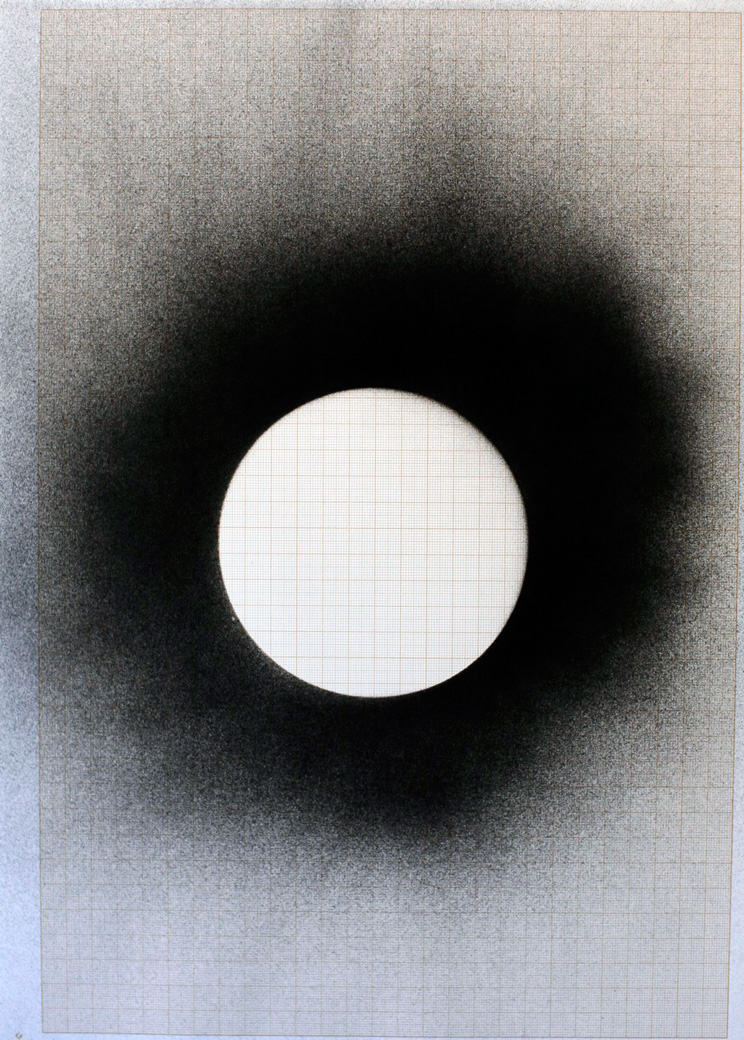
Réalisée en 2011, Intentions est une série de pochoirs à la bombe noire sur papier millimétré. Des formes géométriques élémentaires apparaissent sur une surface associée à la mesure, au dessin technique et à la préparation d’un projet.
Le titre renvoie au sens premier du mot « intention » : l’action de diriger vers, le dessein qui précède l’acte. La grille du papier peut alors être comprise comme l’espace d’un possible, un territoire encore abstrait dans lequel une forme pourrait être située, mesurée et anticipée.
Mais entre l’intention et sa réalisation intervient le geste. Le pochoir impose une règle et un contour, tandis que la bombe dépose physiquement la matière. La forme conçue comme géométrie idéale devient une empreinte. Même minimale, elle porte déjà la trace de son exécution.
Intentions se situe ainsi dans l’écart entre ce qui est projeté et ce qui advient. Carrés, cercles et volumes ne sont pas nécessairement les symboles d’un contenu particulier : ils fonctionnent comme des formes suffisamment élémentaires pour rendre visible le passage d’une idée à sa matérialisation.
La série confronte finalement deux régimes : celui du plan, mesurable et anticipable, et celui de l’action, qui transforme une intention en présence. Le dessin n’est plus seulement la représentation d’une forme. Il devient la trace du moment où une règle rencontre la matière.
Intentions, 2011, Série de pochoir à la bombe noire sur papier millimétré, 42 x 29,7 cm (3 exemplaires de chaques)
Intention. n. f. (lat. intentio » action de diriger vers « ).
1/ Dessein délibéré d’accomplir un acte, volonté.


Created in 2011, Intentions is a series of black spray-paint stencils on graph paper. Elementary geometric forms appear on a surface associated with measurement, technical drawing, and the preparation of a project.
The title refers to the primary meaning of the word “intention”: the act of directing something toward an aim, the plan that precedes action. The grid of the paper can therefore be understood as a space of possibility, an abstract field in which a form may be positioned, measured, and anticipated.
But between intention and realization comes the gesture. The stencil imposes a rule and a contour, while the spray physically deposits the material. A form conceived as ideal geometry becomes an imprint. However minimal it may be, it already bears the trace of its execution.
Intentions thus occupies the gap between what is projected and what actually occurs. Squares, circles, and volumes do not necessarily function as symbols of a specific content; they operate as forms elementary enough to make visible the passage from an idea to its materialization.
The series ultimately confronts two regimes: that of the plan, measurable and foreseeable, and that of action, which transforms an intention into a presence. Drawing is no longer merely the representation of a form. It becomes the trace of the moment when a rule encounters matter.